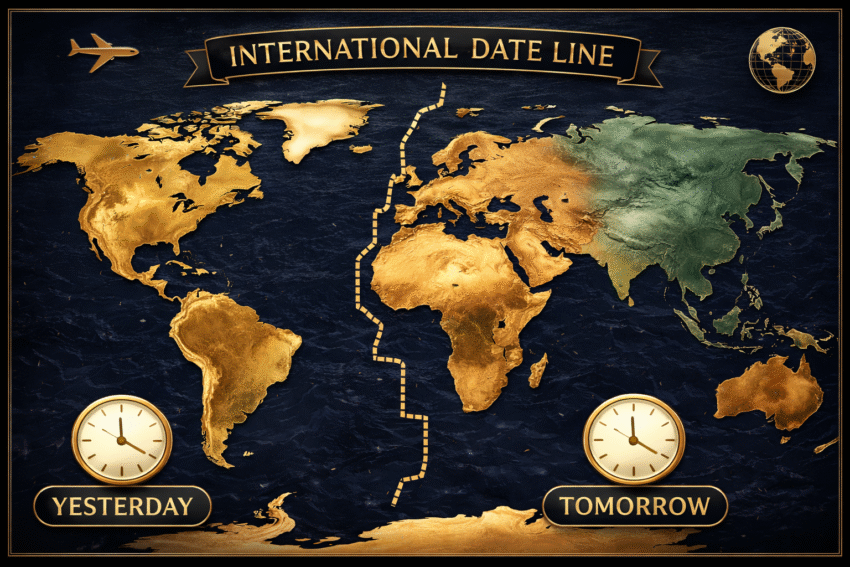
The answer comes down to the International Date Line, and it’s far more political and practical than people realize.
The International Date Line was not drawn by nature, nor declared in a single historic moment—it emerged quietly, shaped by explorers, oceans, and human agreement. As early sailors circled the globe, they discovered that time itself slipped through their hands: sunrise arrived one too many times in one direction, one too few in the other. Somewhere in the vast stillness of the Pacific, a correction had to be made. Over time, that invisible reset settled opposite Greenwich, along the 180th meridian, far from continents and crowded cities. Today, the line bends gracefully around islands and cultures, honoring trade routes, traditions, and unity over mathematical perfection. It is an unseen seam in the world—where yesterday and tomorrow brush past one another—reminding us that time, like travel, is as much about perspective as place.
Why Kiritimati and Baker Island Can Be So Close—Yet Almost a Day Apart
Physically:
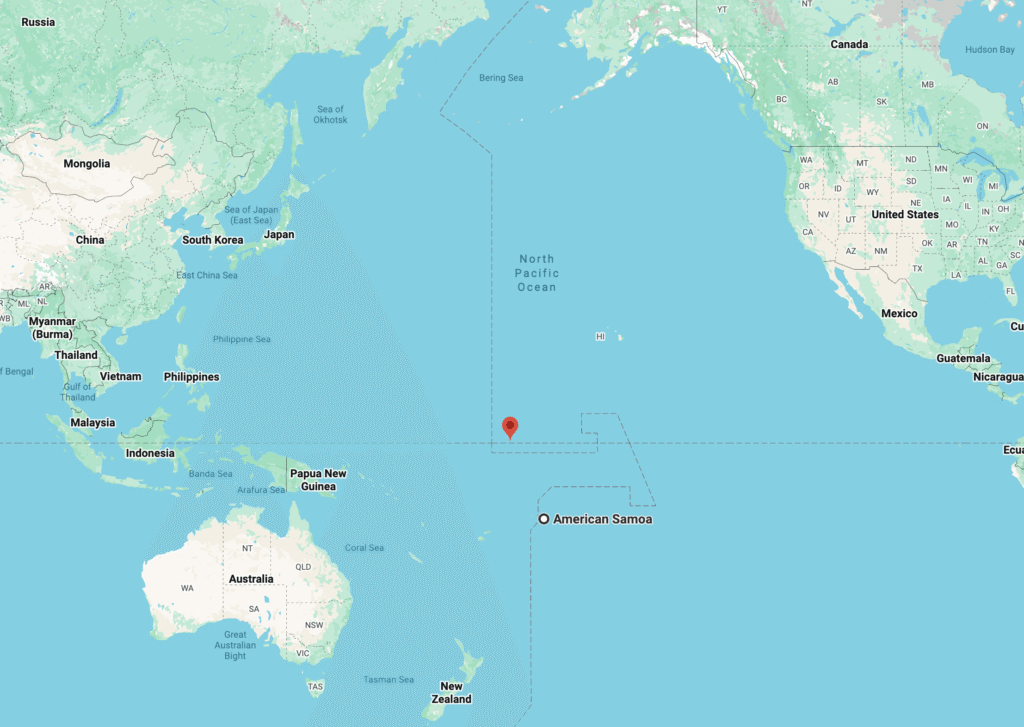
Kiritimati (Christmas Island, Kiribati) and Baker Island are only about 1,300 miles apart in the central Pacific.
In time:
Kiritimati is UTC +14 (the earliest place on Earth)
Baker Island is UTC −12 (the latest place on Earth)
That’s a 26-hour difference—the largest time difference possible anywhere on the planet.
The Real Reason: The International Date Line Is Not Straight
The Earth needs a place where the calendar changes from one day to the next. That imaginary boundary is called the International Date Line (IDL).
But unlike longitude lines, the IDL:
Zigzags
Bends
Moves for political, cultural, and economic reasons
It’s designed to avoid splitting countries or island groups across different calendar days.
What Kiribati Did (And Why It Matters)
Kiribati is a nation made up of islands spread across a huge stretch of the Pacific. Until the 1990s:
Some of its islands were living on different days than the rest of the country.
In 1995, Kiribati made a bold decision:
They shifted the International Date Line eastward around their islands.
This placed all of Kiribati on the same calendar day.
As a result:
Kiritimati jumped to UTC +14
It became the first inhabited place on Earth to welcome the New Year
This change had nothing to do with the sun’s position—and everything to do with unity, governance, and daily life.
Why Baker Island Stayed Behind
Baker Island:
Is uninhabited
Is a U.S. territory
Has no economic or social need to shift time zones
So it remained at UTC −12, on the opposite side of the Date Line.
That’s how:
Two islands in the same ocean
Under the same sky
Can exist on different days entirely
The Bigger, Almost Poetic Takeaway
Time isn’t just astronomical—it’s human-made.
The New Year:
Begins quietly on Kiritimati
Moves westward across the world
Ends silently on Baker Island
Same planet.
Same ocean.
Different agreements about when “tomorrow” begins.
It’s a beautiful reminder that while time feels absolute, the way we experience it is shaped by culture, choice, and meaning.


1 thought on “How are Kiritmati and Baker Island so close but in completely different time zones?”